






Confusion and Truth About International Shoe Size Conversion
If you’re reading this, you’ve found the only conversion guide you need. Congratulations! You don’t have to be confused by international shoe size conversion anymore.
Let’s be honest: most conversion charts on the internet look neat but aren’t entirely correct. I’ve tested them all. After living in Europe, Asia, and North America, I’ve owned shoes labeled UK 4.5, UK5, US 7, US7.5, EU 38e CN 240, yet they all fit differently. My feet never changed—but brand interpretations of “size” certainly did.
The truth is that there is no single global shoe size standard. Every region—and sometimes even every brand—defines its sizing slightly differently. In this guide, you’ll learn how each system works, how to measure your foot correctly, and how to convert across US, UK, EU, and China systems with confidence.
Below is an international footwear size chart I got from a local outlet. You can roughly determine your shoe size range through it and try them on, but don’t take it as the absolute truth. We will elaborate on this later. Each brand has significant differences.

What “Shoe Size Conversion” Really Means
When you see a chart saying “US 7 = EU 38 = UK 5”, it’s only a simplified approximation.
Here’s why:
- The US system starts its scale differently for men and women, and each step equals roughly one-third inch.
- The UK system begins 1 size smaller than the US, using its own “last length” base.
- The EU system is based on Paris Points—each point equals ⅔ of a centimeter, and the scale is unisex.
- The China (or Mondopoint) system usually measures foot length in millimeters, often printed as “240 mm,” “245 mm,” etc.
Each brand applies these systems to its unique shoe molds, which means a “US 8” from Nike might not match an “US 8” from Adidas. That’s why you can’t rely on one universal chart from the web.
The Meaning Behind Each International Size System
1. US Shoe Sizes
- Separate scales for men, women, and children.
- Generally, men’s size = women’s size − 1.5 (e.g., men’s 8 = women’s 9.5).
- Commonly used in the United States and parts of Latin America.
2. UK Shoe Sizes
- Similar to US but roughly 0.5 size smaller (men’s 8 US ≈ 7.5 UK).
- Originated from the “Barleycorn” unit—a traditional English measure.
3. EU Shoe Sizes (Continental)
- Based on Paris Points. One size = 6.67 mm.
- No gender separation. An EU 38 could fit both men’s 6 or women’s 7.5 US, depending on brand.
4. China / Mondopoint System
- Expressed directly in millimeters of foot length, e.g., “240 mm” or “24.0 cm.”
- Some brands in Asia, such as Li-Ning or Anta, use this system exclusively.
The Only Measurement That Never Lies: Foot Length
No matter where you shop, your foot length stays constant. Measuring it correctly is the foundation of all reliable conversions.
🦶 How to Measure Your Foot (Step by Step)
- Place a sheet of paper flat against a wall on the floor.
- Stand on it with your heel gently touching the wall.
- Mark the tip of your longest toe.
- Measure from the wall edge to the toe mark using a ruler.
- Record the number in millimeters (mm) or centimeters (cm).
- Repeat for your other foot—use the longer length.
✅ Tip: Always measure at the end of the day when your feet are slightly larger, and wear socks similar to the ones you’ll use with the shoes.
Once you have this length, go to the brand’s official size guide. Brands like Nike, Adidase Converse offer tables that map exact foot lengths to their sizes. That’s far more accurate than relying on generic conversion charts.

Brand-Specific Shoe Size Conversion Tables
Below are examples of approximate brand conversions. Always confirm with each official site.
Nike Shoe Size Conversion
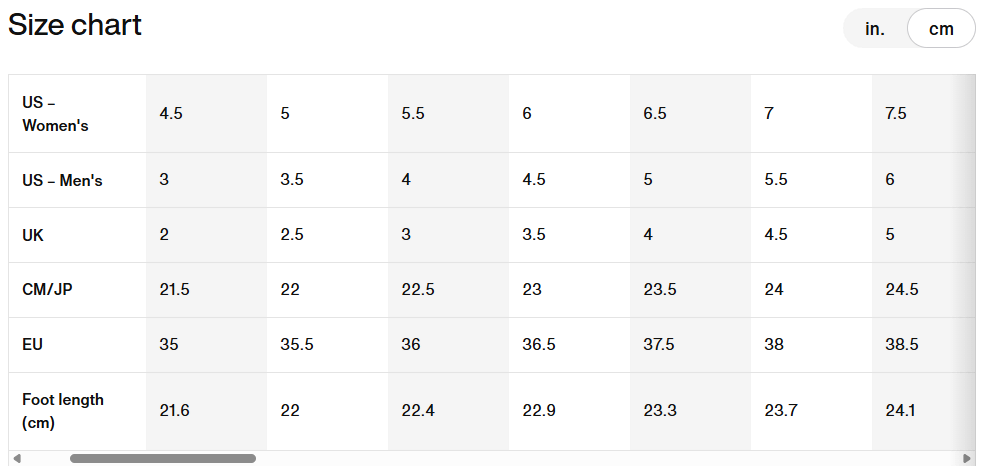
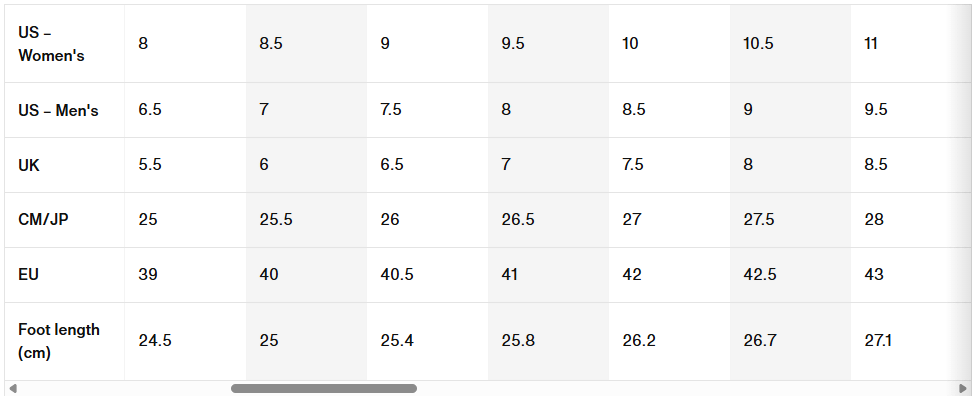
Note: Nike tends to run slightly narrow; consider half a size up for wider feet.
Adidas Shoe Size Conversion
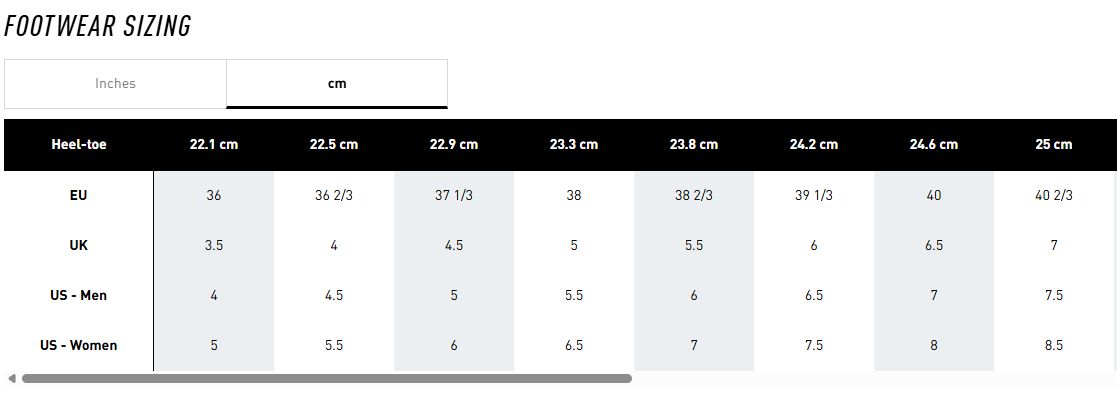
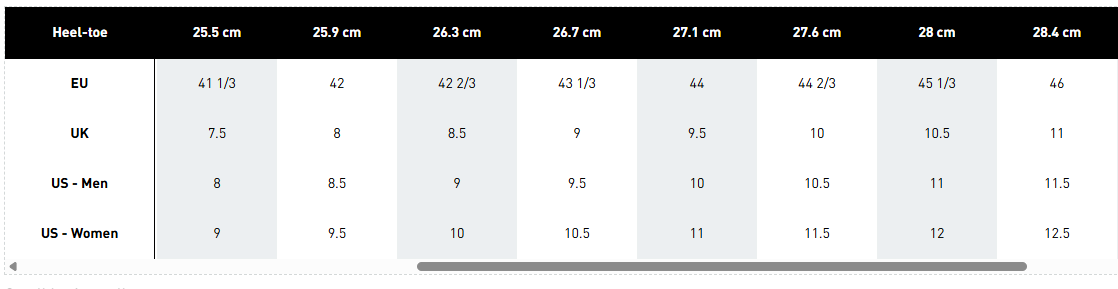
| US (Men) | UK | EU | China (mm) |
|---|---|---|---|
| 6 | 5.5 | 38 ⅔ | 240 |
| 7 | 6.5 | 40 | 250 |
| 8 | 7.5 | 41 ⅓ | 260 |
| 9 | 8.5 | 42 ⅔ | 270 |
| 10 | 9.5 | 44 | 280 |
Adidas shoes often run true to size compared with Nike.
Converse Shoe Size Conversion
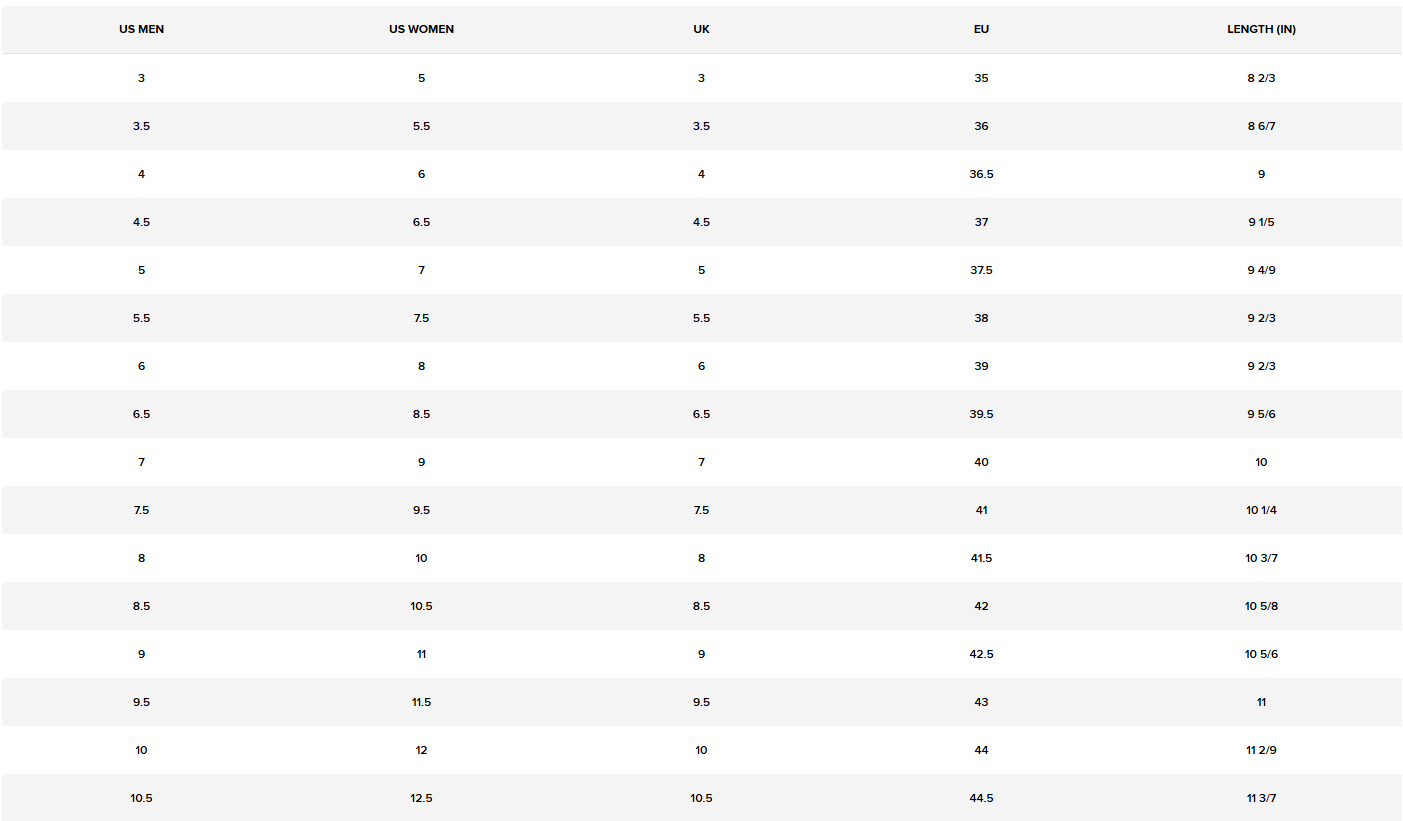
Converse shoes are generally half a size larger than standard sneakers.
Birkenstock Shoe Size Conversion
Birkenstock offers an easy-to-download A4-sized version. You can simply click here to print it out and measure your foot length. Then, match it with your shoe size.
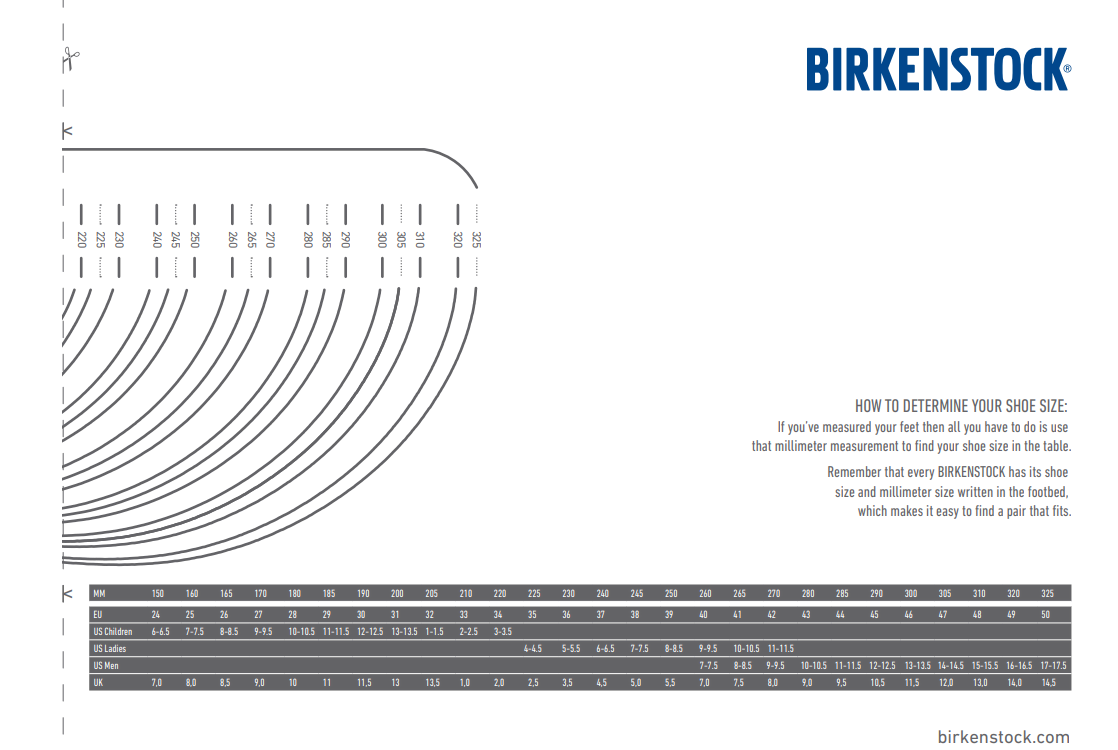
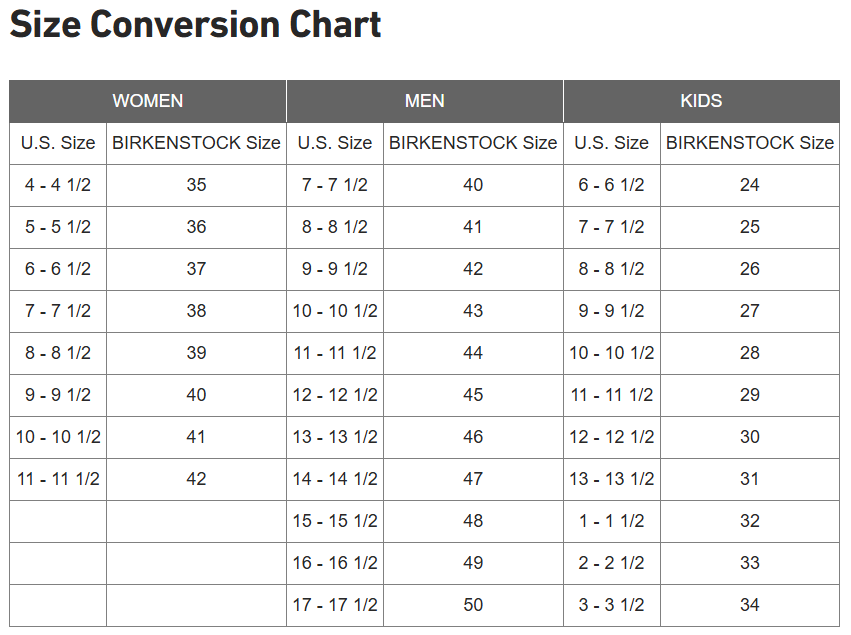
Birkenstocks follow EU sizing closely—measure your foot length before choosing.
The Common (But Imperfect) Shoe Size Conversion Formula
If you still need a general conversion, here’s a rough formula many websites use:
US → EU (approx.)
EU = (US × 1.27) + 18
US → UK
UK = US − 0.5
EU → China (mm)
mm = EU × 6.67
These formulas only provide an estimated match. Use them for reference—but always adjust based on foot length and brand.
If you want a visual reference, download or pin a full US UK EU China shoe size chart image that matches this table—it’s handy for quick checks.
FAQs: Everything You Wanted to Know About Shoe Size Conversion
Q1. Why are most online conversion charts inaccurate?
Because there’s no single international shoe sizing standard. Each brand’s internal scale can vary up to half a size.
Q2. Is it safe to always go one size up or down when converting?
Not really. Shoe shapes differ by brand and region. Always confirm with the specific brand chart.
Q3. What if my feet are between two sizes?
Choose the larger one. You can use insoles or thicker socks for adjustment.
Q4. Do men’s and women’s conversions differ?
Yes—women’s sizes are generally 1.5 larger than men’s in US systems (US 8 W ≈ US 6.5 M).
Q5. How do Chinese sizes relate to EU or US?
China typically measures foot length in mm, which can be mapped roughly by the formula above. For instance, 250 mm ≈ US 7 ≈ EU 40.
Q6. Do children’s shoes follow the same scale?
No, kids’ systems start from a different baseline. Always check the age-specific chart from the brand.
Considerações finais
There’s a reason your “perfect fit” sneakers from one country feel tight when you buy them elsewhere: shoe size conversion is not an exact science.
The most reliable way is simple:
- Measure your foot length accurately.
- Check the brand’s official chart.
- Use conversion tables as rough guidance only.
- When possible, try shoes on before buying.
Bookmark this guide for reference the next time you shop abroad—you’ll never guess your size again.

Ivy is a Sourcing Specialist at Sellers Union. She shares hands-on experience in supplier selection, quality control, and market trends to help global wholesalers make informed decisions. Her goal is to simplify the sourcing process and help brands build efficient supply chains in the industry.